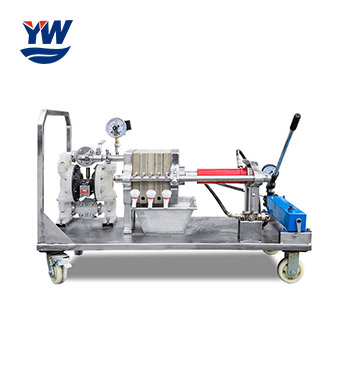
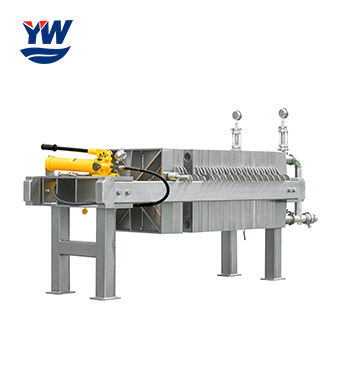
A Lab Filter Press is a compact, high-precision solid-liquid separation unit explicitly designed for laboratory research, feasibility studies, and small-batch production. Before investing in large-scale industrial filtration, engineers and researchers rely on these benchtop and pilot-scale presses to test slurry characteristics, determine optimal filter media, and accurately predict full-scale dewatering performance.
At Yuwei Filtration Equipment, we manufacture highly versatile lab-scale filter presses available in manual, hydraulic, and pneumatic configurations. Whether you require a miniature 304/316L stainless steel plate and frame press for sanitary pharmaceutical research or a compact membrane press for chemical testing, our lab solutions deliver industrial-grade pressure and precise data scalability in a minimal footprint.
In chemical engineering, metallurgy, and biotech processing, transitioning directly from a theoretical formula to full-scale industrial production carries significant financial risk. The Lab Filter Press mitigates this risk by serving as the ultimate pilot-testing tool. It allows R&D teams to simulate the exact mechanical and hydraulic conditions of a massive industrial press using only a few liters of sample slurry.
Using a Yuwei lab filter press provides engineers with empirical data that is 100% scalable to our heavy-duty industrial models. By running a sample batch, you can accurately determine:
Despite their small footprint, our laboratory filter presses are built with the same robust engineering standards as our 2000mm industrial behemoths:
Our lab-scale equipment is designed to fit seamlessly into research environments, fume hoods, or pilot plant testing bays.
| Filter Plate Size (mm) | Typical Filtration Area | Chamber Volume | Clamping Mechanism | Best For |
|---|---|---|---|---|
| 250 * 250 | 0.1m² – 0.5m² | 1L – 5L | Manual Jack / Hand-Wheel | University Labs, Basic R&D |
| 315 * 315 / 320 * 320 | 0.5m² – 2.0m² | 5L – 15L | Manual Hydraulic | Small Batch Production |
| 400 * 400 | 1.0m² – 4.0m² | 10L – 40L | Manual / Automatic Hydraulic | Pilot Plant Testing |
Logistics & Lab Integration Note: While these units are categorized as “miniature,” their solid steel skeletons and heavy-duty hydraulic components mean their Operating Weight can range from 150 Kg to over 500 Kg. When planning for a benchtop installation, ensure your laboratory workbench or mobile testing cart has the structural load-bearing capacity to safely support this static weight under high-pressure operation.
Yes. Our laboratory filter presses are designed to withstand the exact same feed pressures as our industrial units (typically 0.6 MPa to 1.5 MPa), ensuring that your pilot data perfectly mirrors actual industrial conditions.
We provide a “dummy plate” (backing plate) accessory with our lab units. By inserting this plate, you can block off unnecessary chambers, effectively reducing the filtration volume to match your tiny sample size without compromising the high-pressure filtration dynamics.
For our smallest 250mm models, a manual hand-wheel or mechanical jack is extremely easy to operate and requires minimal physical effort. For 315mm and 400mm models, we utilize a manual hydraulic hand-pump (similar to a pallet jack) which effortlessly generates tons of clamping force.